New customer offer: Save £30 on your first weight loss consultation with code WLNC30 | T&Cs apply*



Scott Weaver
Updated at: March 09, 2026 · 8 min read
How Can I Get Rid Of A Migraine?
In One Sentence: You can get rid of a migraine by acting quickly with the right medicines, resting in a dark and quiet room, and learning your personal triggers to stop future attacks.
Migraines are much more than just a bad headache. They are a complex whole body experience that affects millions of people across the UK. A severe attack can make even the simplest tasks, like looking at a screen or listening to music, feel completely impossible. While there is no permanent cure, there are many highly effective ways to stop the pain in its tracks. In this guide by UK Meds, we will explore exactly how to get rid of a migraine quickly using pharmacy treatments, prescription medicines, and simple home remedies.
If over-the-counter painkillers like paracetamol or ibuprofen are not providing enough relief, you may need to complete a medical consultation to order Sumatriptan, a targeted triptan designed to quickly reverse the widening of blood vessels in the brain.
Key Takeaways
What is the fastest way to stop a migraine?
The fastest way is to take your medication the moment you notice the very first warning signs. Do not wait for the headache to get worse.
Can I cure my migraines forever?
No, there is currently no permanent cure. However, you can manage them very well to make attacks much less frequent and far less painful.
What home remedies work best?
Using cold compresses, drinking plenty of water, and resting in a dark room can help ease your pain and calm your nervous system naturally.
What is the fastest way to get rid of a migraine?
The fastest way to get rid of a migraine is to take your medication the moment you notice the first warning signs. Do not wait for the headache to get severe. Combine your medicine with rest in a dark, quiet room to help your body recover quickly.
Timing is everything. Many people experience a warning stage called the "prodrome" phase before the actual pain starts. During this time, you might feel unusually tired, crave sweet foods, or notice a stiff neck. Some people also get an "aura", which involves seeing flashing lights or zigzag lines. Taking your treatment during these early stages gives the medicine time to absorb and stop the attack from reaching its peak.[1]
Video: A pharmacist explains how to get migraine relief from headache pain at home
In the video below, pharmacist Abraham Khodadi (MPharm(Hons) IPresc MScACP), provides an overview of what to do to achieve relief from a migraine at home:
Which medicines work best for migraine relief?
Over the counter painkillers like ibuprofen or paracetamol are great for mild attacks. For stronger pain, your doctor can prescribe triptans like Sumatriptan or Rizatriptan, which reverse the changes in your brain that cause the headache. Anti sickness tablets can also help if you feel nauseous.
Finding the right treatment can take a little bit of trial and error. Here are the main options available to you according to NICE guidelines:[2]
Medicine Type | How it works | Common Examples |
| Standard Painkillers | Blocks general pain signals. Soluble versions in water work the fastest. | Paracetamol, Ibuprofen, Aspirin. |
| Triptans | Reverses widened blood vessels in the brain specific to migraines. | Sumatriptan, Rizatriptan. |
| Anti-emetics | Stops you from feeling sick or vomiting during a severe attack. | Prochlorperazine, Metoclopramide. |
Important Rule: Do not take standard painkillers on more than 15 days a month, or triptans on more than 10 days a month. Taking them too often can cause your body to rely on them, leading to a "medication overuse headache".[2]

How can I ease migraine symptoms at home?
You can ease migraine symptoms at home by wearing a migraine relief cap, drinking plenty of water, and massaging your neck. Staying away from bright lights and loud noises will also help calm your nervous system.
Creating an emergency "migraine kit" at home or at work is a great idea. Having the right tools ready can make a big difference. Try these simple NHS backed techniques:
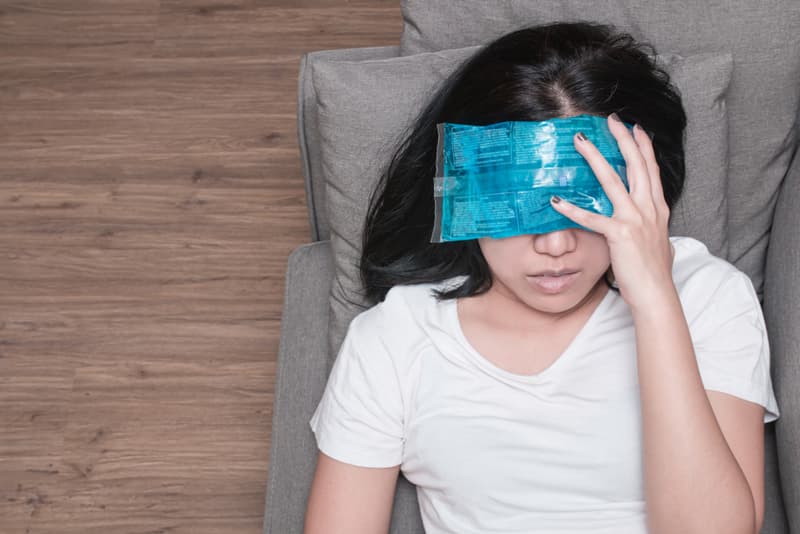
Use a standard cold compress: If you do not have a migraine cap, placing an ice pack wrapped in a towel on your head can still slow down nerve signals and reduce the throbbing pain.[3]
Stay hydrated: Dehydration is a huge trigger. Keep sipping water. Some people find a small amount of caffeine (like a cup of tea) helps painkillers work faster, but do not drink too much.
Block out the light: Sensitivity to light is very common. If you are not using a migraine cap, draw the curtains, turn off your screens, and wear a simple eye mask to give your brain a rest.
Wear a migraine relief cap: These are wearable hats you keep in the fridge or freezer. They wrap completely around your head to provide 360 degree cold therapy, while pulling down over your eyes to block out painful bright lights. This covers two treatments in one simple step.
Try ginger: Research shows that ginger tea or ginger sweets can help reduce the feelings of nausea that come with a severe headache.[4]
What causes migraines and how can I prevent them?
Migraines are caused by changes in your brain and blood vessels, usually set off by personal triggers like stress, skipping meals, or hormonal changes. You can prevent them by tracking your triggers in a diary and taking daily preventative medicines if needed.
If you suffer from frequent attacks, speaking to a GP is vital. They might prescribe a daily preventative medicine, such as Propranolol or Topiramate.[5] You take these every single day to make your brain less sensitive to triggers.
You can also prevent attacks by maintaining a strict, healthy routine. Go to sleep at the same time every night, do not skip meals, and find ways to manage your stress. Yoga, deep breathing, and regular gentle exercise can drastically reduce how often you get a headache.
When should I seek urgent medical help?
You must call 999 immediately if your headache is sudden and blinding, or if you also have a stiff neck, a high temperature, or weakness on one side of your face or body. These could be signs of a stroke or meningitis.[6]
You should also seek urgent advice from NHS 111 if your migraine has lasted for more than 72 hours without a break, or if your aura symptoms (like blurred vision) last for longer than an hour at a time.
Frequently Asked Questions
What is a migraine aura?
An aura is a warning sign that happens just before a migraine hits. It usually involves problems with your sight, like seeing flashing lights or zigzag lines. Some people also feel numbness or pins and needles in their hands or face.
Does chocolate trigger migraines?
Many people crave sweet foods like chocolate right before an attack starts. Because of this, people often blame the chocolate for causing the pain. However, the craving is actually just an early symptom of the migraine already beginning.[7]
Can I take triptans every day to stop the pain?
No. Triptans are "rescue" medicines used only when an attack happens. You should not take them on more than 10 days a month. If you need medicine more often than that, you need to speak to a doctor about daily preventative tablets instead.
Final Thoughts From Our Clinical Team
'Treating a migraine effectively is a race against the clock. The biggest mistake patients make is waiting to see if the headache gets worse before taking their medication. Whether you rely on soluble ibuprofen or a targeted triptan like Sumatriptan, you must take it at the very first sign of pain or visual disturbance. Pair your medicine with a dark room and a large glass of water for the best results. If you find yourself needing painkillers more than twice a week, please speak to your doctor about daily preventative treatments to protect your long term health.'
Sources and References
Marmura, M. J., et al. The American Headache Society Assessment of Acute Treatments for Migraine. Headache: The Journal of Head and Face Pain.
National Institute for Health and Care Excellence (NICE). NICE Clinical Guideline [CG150]: Headaches in over 12s: diagnosis and management.
Hsu, Y. Y., et al. (2022). Cold intervention for relieving migraine symptoms: A systematic review and meta-analysis. Journal of Clinical Nursing.
Maghbooli, M., et al. Comparison between the efficacy of ginger and sumatriptan in the ablative treatment of the common migraine. Phytotherapy Research.
British Association for the Study of Headache (BASH).National Headache Management System for Adults.
Do, T. P., et al.Red and orange flags for secondary headaches in clinical practice: SNNOOP10 list. Neurology.
Nowaczewska, M., et al. Chocolate is a prodrome of migraine attacks, not a trigger: A literature review. Nutrients.
Related Blog Posts




Related Treatment
Related Treatment
Blog author


Scott Weaver
Scott is an experienced and professional content writer who works exclusively for UK Meds.
Content last updated:

Related Blog Posts




Here to help you
Our Customer Service is available Monday to Friday 9am - 5pm. If you need urgent assistance, do not use this service. Call 111, or in an emergency call 999. Visit our help section